How Georgia's Red Clay Affects Your Gutter Drainage (And What to Do About It)

Anyone who's lived in Metro Atlanta for more than one rainy season knows the struggle: water pools in the yard, the ground stays soggy for days, and that distinctive red mud gets tracked everywhere.
What you might not realize is that Georgia's red clay doesn't just make a mess of your shoes. It fundamentally changes how your entire gutter system needs to work. The same soil that gives our state its character also creates drainage challenges that can damage your foundation, erode your landscaping, and turn your yard into a swamp.
Here's what every Georgia homeowner needs to understand about red clay and gutter drainage.
What Makes Georgia Red Clay So Different?
Georgia's red clay isn't technically "clay" in the pure sense. It's classified as Ultisol, a type of soil that formed over hundreds of thousands of years of weathering. The red color comes from iron oxide (essentially rust) that accumulated as minerals broke down.
But from a drainage perspective, what matters is how it behaves:
It's incredibly dense. Clay particles are the smallest of all soil types. They pack together so tightly there's almost no space for water to pass through.
It absorbs water extremely slowly. While sandy soil might drain an inch of water in minutes, clay soil can take 4-5 times longer, and sometimes much more.
It holds water like a bowl. Once saturated, red clay doesn't release moisture easily. After a heavy rain, your yard can stay waterlogged for days.
It swells when wet, shrinks when dry. This expansion and contraction cycle is particularly hard on foundations, and it's directly related to how water accumulates around your home.
According to University of Georgia soil experts, this dense composition means water can't filter through the ground naturally. Instead, it runs across the surface, pooling in low spots and, if your gutters aren't doing their job, collecting right against your foundation.
Why Standard Gutter Advice Doesn't Work in Georgia
Most gutter installation guides are written for "average" soil conditions. They'll tell you to extend downspouts 4-6 feet from your foundation and call it good.
In Georgia's red clay? That's often not enough.
Here's the problem: when your downspouts dump water onto clay soil, it doesn't soak in and disperse like it would in sandy or loamy ground. Instead, it sits there. If there's any slope back toward your house, even a subtle one you can't see with the naked eye, that water will migrate right back to your foundation.
We see this constantly on homes across Marietta, Sandy Springs, and Smyrna. The homeowner has gutters, has downspout extensions, and still ends up with water in the basement or cracks in the foundation. The gutters are working fine. The soil just isn't cooperating.
The Real Risks: What Happens When Clay Meets Poor Drainage
When water consistently pools around your foundation in clay soil, you're looking at a cascade of potential problems:
Foundation Damage
Georgia's red clay expands when it absorbs water, sometimes significantly. This expansion creates lateral pressure against your foundation walls. Over time, this can cause:
- Cracks in foundation walls and floors
- Bowing or leaning walls
- Doors and windows that stick or won't close properly
- Uneven floors
When the clay dries out, it shrinks and pulls away from the foundation, creating voids that can lead to settling. This wet-dry cycle is particularly destructive, and it happens every time we go from a rainy period to a dry spell.
Basement and Crawl Space Water Intrusion
Hydrostatic pressure, the force of water pushing against your foundation, increases dramatically when water can't drain away. In clay soil, this pressure builds faster and lasts longer than in well-draining soil. The result: water finds its way through any crack, joint, or porous spot in your foundation.
Erosion and Landscape Damage
When water sheets across saturated clay instead of soaking in, it picks up speed and starts carrying soil with it. You'll see this as:
- Channels forming in mulch beds
- Exposed root systems
- Washout areas near downspouts
- Red clay staining on driveways, sidewalks, and siding
Soggy, Unusable Yards
A yard that stays wet for days after every rain isn't just annoying. It kills grass, breeds mosquitoes, and makes outdoor spaces unusable for much of the year.
What Your Gutters and Downspouts Need to Do Differently
Given Georgia's soil conditions, here's how to approach gutter drainage effectively:
1. Extend Downspouts Farther Than You Think
The standard recommendation is 4-6 feet from the foundation. For clay soil, push that to 8-10 feet minimum. Some drainage experts recommend even farther for properties with slopes or high water tables.
The goal isn't just to get water away from your foundation. It's to deposit it somewhere it can actually drain or flow away from your home entirely.
2. Check Where That Water Actually Goes
Here's a test we recommend: during a heavy rain, go outside and watch where your downspout water flows. Does it continue moving away from your house? Or does it pool, sit, and eventually creep back toward the foundation?
In clay soil, even a barely perceptible slope toward your house can redirect water back where you don't want it. You might need to regrade the area around your downspout outlets or install underground drainage to carry water to a better location.
3. Consider Underground Drainage Systems
For many Georgia homes, surface extensions aren't enough. Underground drainage using rigid PVC pipe buried in a trench with proper slope can carry water much farther from your foundation than surface solutions.
Key considerations for underground drainage in clay:
- Use rigid pipe, not corrugated. Flexible corrugated pipe crushes easily under clay's weight and clogs quickly with sediment.
- Ensure proper slope. At least 1-2 inches of drop per 10 feet of pipe length.
- Create a proper outlet. Water needs somewhere to go, whether that's a dry well, drainage swale, or daylight outlet away from structures.
- Install cleanouts. Fine clay particles inevitably enter the system, so you'll need access points to flush the lines.
4. Don't Neglect the Gutters Themselves
All the downspout engineering in the world won't help if your gutters aren't doing their job in the first place. In Georgia, that means:
Sizing matters. With 50+ inches of annual rainfall and intense summer storms, standard 5-inch gutters may not handle peak flow. Many homes benefit from 6-inch gutters, especially on larger roof sections.
Seamless is better for clay country. Sectional gutter seams can leak, depositing water right against the foundation in concentrated spots. Seamless gutters eliminate most of those failure points.
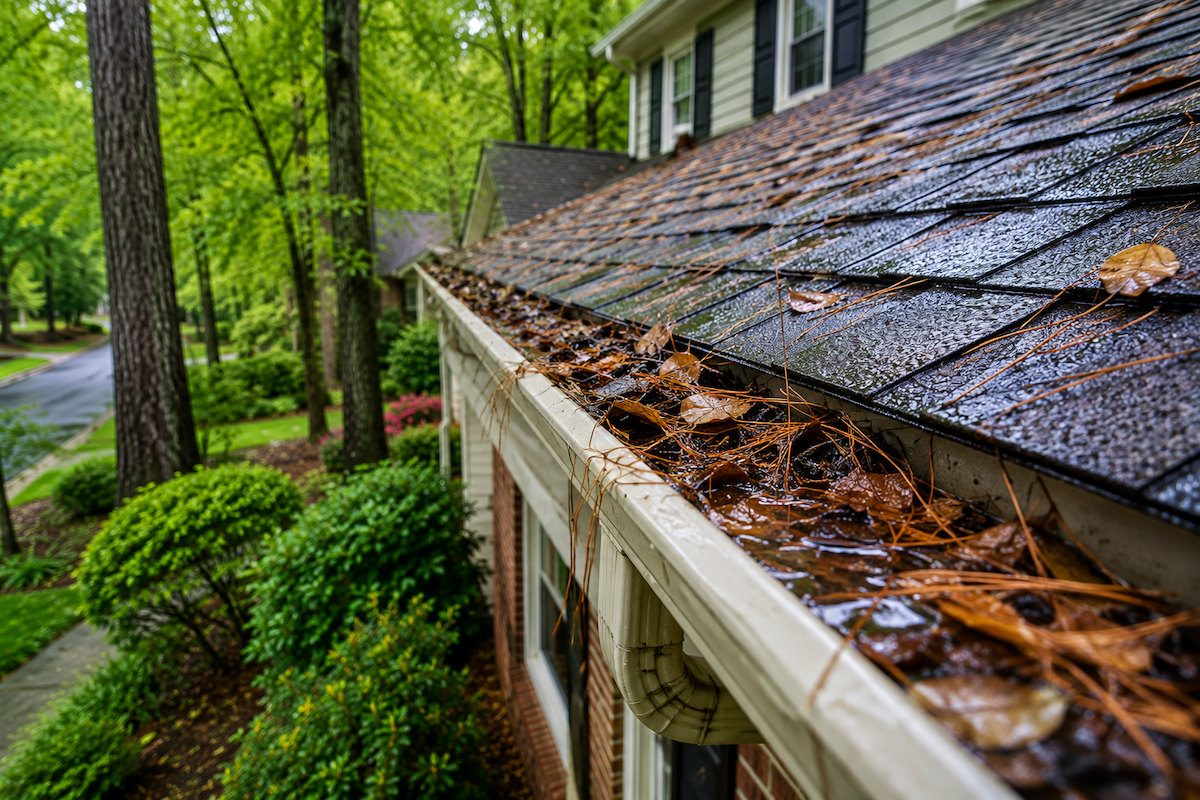
Gutter guards reduce maintenance. Atlanta's tree canopy is beautiful, but pine needles and oak leaves clog gutters fast. Clogged gutters overflow, and that overflow runs right down your siding and pools at your foundation.
5. Grade the Soil Around Your Foundation
The ground immediately around your home should slope away at roughly 6 inches over the first 10 feet. In clay soil, this grading is critical because you can't rely on absorption to handle water near the foundation.
Interestingly, when adding soil for grading purposes, dense material (including clay) is actually preferred over sand or mulch. Sand drains water straight down to your foundation, while clay encourages water to sheet away on the surface.
Signs Your Current Drainage Isn't Working
How do you know if Georgia's clay is winning the battle against your gutters? Watch for these warning signs:
- Standing water within 10 feet of your foundation after moderate rain
- Soggy or perpetually damp areas near downspout outlets
- Erosion channels in mulch beds or lawn areas
- Red clay staining on foundation walls, siding, or walkways
- Cracks in foundation walls or floors, especially horizontal cracks, which indicate lateral pressure
- Musty smells in basement or crawl space
- Efflorescence, the white mineral deposits on basement walls
- Doors or windows that suddenly stick or won't close properly
If you're seeing multiple signs, the issue isn't going away on its own. Clay soil conditions don't improve without intervention.
A Note on Newer Construction
Homes built in the last 20-30 years in Metro Atlanta face a particular challenge. When your home was constructed, the area around the foundation was excavated and then backfilled. That backfilled soil, even if it's the same red clay, is looser and more porous than the undisturbed soil around it.
This creates what foundation experts call a "false water table": rain and runoff collect preferentially in that loose backfill zone right against your foundation. It's one reason why proper drainage is even more critical for newer homes, even though you might expect older homes to have more problems.
The Bottom Line for Georgia Homeowners
Georgia's red clay is part of what makes this region unique, but it demands respect when it comes to water management. Your gutter system isn't just about keeping rain off your roof. It's about controlling where that water goes after it leaves the downspouts.
The combination of 50+ inches of annual rainfall, intense summer storms, and soil that refuses to drain means Georgia homes need more robust drainage solutions than properties in other parts of the country.
The good news: with proper planning and installation, these challenges are completely manageable. Homes throughout Metro Atlanta handle clay soil just fine. They just need systems designed for local conditions rather than generic national standards.
Questions About Your Gutter Drainage?
If you're dealing with water pooling near your foundation, erosion around downspouts, or signs of moisture intrusion, we're happy to take a look. At Right Hand Roofing & Gutters, we've been working on homes across Georgia and Alabama since 2005, and we understand how local soil conditions affect everything from gutter sizing to downspout placement.
Call us at 678-840-2255 or schedule your free assessment to discuss your drainage concerns.
Frequently Asked Questions
How far should downspouts extend from the foundation in Georgia?
In clay soil, extend downspouts at least 8-10 feet from your foundation, and farther if your property slopes back toward the house. The standard 4-6 foot recommendation works for well-draining soil but often isn't sufficient for Georgia's red clay.
Why does water pool in my yard even though I have gutters?
Your gutters may be working perfectly, but if the downspouts deposit water onto saturated clay soil, it has nowhere to go. The solution usually involves extending downspouts farther, installing underground drainage, or regrading problem areas.
Can I just add sand to improve drainage around my foundation?
This is generally not recommended. Sand drains water straight down, right to your foundation. For grading purposes, dense soil (including clay) that sheds water away from the foundation is actually preferred. For drainage systems like French drains, gravel is used to create channels for water movement.
How often should I clean gutters in Georgia?
With Atlanta's heavy tree coverage, plan on cleaning gutters at least twice per year, once in late fall after leaves drop and once in spring after pollen season. Homes with significant pine tree coverage may need more frequent cleaning. Gutter guards can reduce (but not eliminate) this maintenance.
Do I need 6-inch gutters instead of 5-inch?
It depends on your roof size and slope. Larger roof sections or steep pitches channel more water, faster. Given Georgia's intense rainfall, many homes benefit from 6-inch gutters on at least some sections. We can assess your specific situation during a consultation.
Right Hand Roofing & Gutters is a family-owned company serving Georgia and Alabama since 2005. We specialize in roofing, seamless gutter installation, and comprehensive drainage solutions designed for local conditions.














.webp)
.webp)
.webp)
.webp)
.webp)
.webp)


.webp)
.webp)
.webp)

.jpg)


.jpg)